

Artificial intelligence, cloud computing and digital services continue to drive demand for data center capacity. At the same time, owners are navigating constraints involving available power, suitable land and long lead times for critical electrical equipment.
Lawrence Berkeley National Laboratory estimates that data centers could account for approximately 11.8% of total U.S. electricity use by 2030. In June 2026, the Federal Energy Regulatory Commission directed the six regional grid operators under its jurisdiction to justify or reform the rules governing how data centers and other large energy users connect to the grid. Both developments underscore the importance of addressing power availability early in data center planning.
Large, multi-building campuses will remain part of the market, but not every owner needs to begin at that scale.
Clinton Kurtz, Vice President of Mission Critical at H. J. Russell & Company, believes owners should first determine what the facility needs to accomplish.
“Not every owner needs a massive campus on day one,” Kurtz said. “The first step is understanding the organization’s current capacity needs, where that capacity is needed and how demand is expected to grow.”

Vice President of Mission Critical
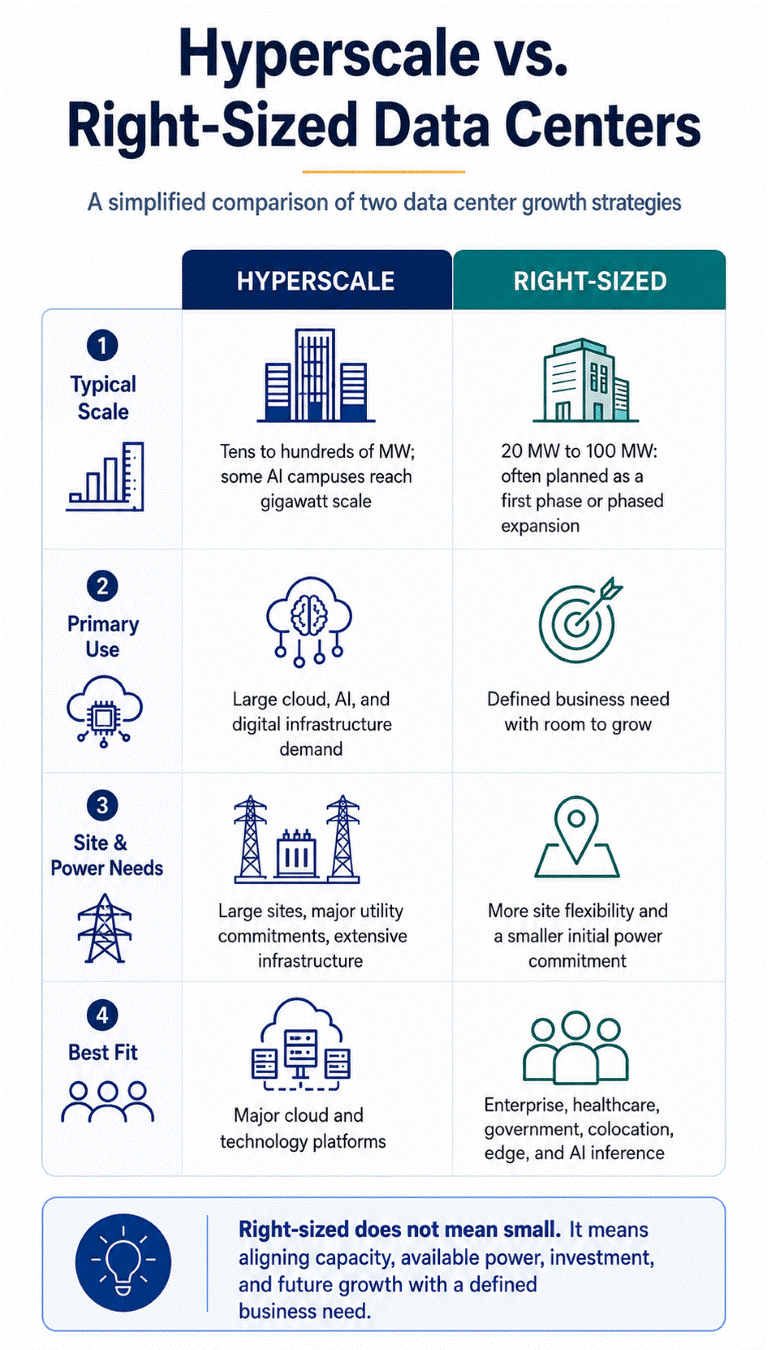
Large financial institutions, healthcare systems, government agencies and enterprise organizations may require highly available, secure and resilient infrastructure without needing a multi-building campus. Colocation providers, regional cloud platforms, edge computing operators and companies supporting AI inference may also benefit from facilities located closer to the customers or operations they serve.
Their expectations for speed, reliability, security and redundancy remain high. What differs is the amount of capacity required, how it will be used and how quickly demand is expected to increase.
Building around demonstrated demand can help an owner avoid constructing, powering and maintaining capacity that may remain unused for years. It also connects the initial investment more closely to the organization’s operating plan.
Data centers require substantial investments in land, power, equipment and supporting infrastructure. Starting with a focused first phase can reduce the amount of capital committed before additional capacity is needed.
A right-sized facility will not always have a lower construction cost per megawatt. It can, however, allow the owner to align the initial investment with current demand and add capacity as the business grows.
That approach depends on planning for the full development from the beginning. The site plan and major building systems should account for future power, cooling, equipment, utility infrastructure and construction access. Owners should also confirm that the property, zoning and available utility capacity can support the anticipated buildout, not only the first phase.
“Future expansion cannot be an afterthought,” Kurtz said. “An owner may choose to build less capacity initially, but the site and major systems should be planned with the full buildout in mind.”
Completing site investigations, utility coordination and infrastructure planning during the first phase may make future development more manageable. Additional permits and utility approvals may still be required, but the owner will not be starting over at a new location.
Future construction must also be planned around active operations. Access routes, utility connections, shutdowns, equipment deliveries and turnover activities should be considered early so expansion does not compromise the security or performance of the operating facility.
Computing equipment and cooling requirements continue to evolve. Owners must consider how a facility will respond to greater computing demand without requiring extensive redesign or disrupting active operations.
The first phase should account for future electrical loads, cooling strategies, fiber connectivity, equipment space and secure access for later construction. Higher rack densities and the increased use of liquid cooling may also affect how owners plan future power and infrastructure needs.
The goal is not to predict every technology that may emerge during the life of the facility. It is to preserve enough flexibility to accommodate change without unnecessarily removing or replacing major systems.
Owners should also identify what will trigger the next phase. Expansion may be tied to customer commitments, utilization, operating requirements or projected computing demand. Establishing those triggers early can help the owner determine when additional investment is warranted.
Early construction involvement gives owners better information before major design, procurement and investment decisions are finalized. Contractors and trade partners can help test the budget, identify long-lead equipment, evaluate site logistics and develop a schedule based on how the work will actually be built.
“The schedule should be developed with direct input from the people who will build the data center, not separately from the construction team,” Kurtz said. “When contractors and trade partners are involved early, the owner gets better information about cost, procurement, logistics and how the work will actually be completed.”
This early planning helps owners identify risks before they affect cost, schedule or operations. It also supports better coordination around equipment deliveries, secure work areas, utility connections, testing and commissioning.
Regardless of size, a data center must be planned and built around reliability, redundancy, security and operational readiness. H. J. Russell & Company brings mission critical experience involving high-capacity electrical systems, long-lead procurement, phased construction, quality control and commissioning.
For owners considering a 20 MW to 100 MW facility or phased development, right-sizing is not simply about building less. It is about aligning capacity, available power, investment and future expansion from the start. H. J. Russell’s mission critical team is prepared to help owners, developers and enterprise organizations move from concept to capacity with greater confidence.